Introduction
As India’s DPDP compliance framework shifts from intent to execution, Consent Managers and consent management platforms (CMPs) are increasingly shaping how organisations interpret the Digital Personal Data Protection Act, 2023 (DPDP / DPDPA 2023). With the DPDP Rules now notified and enterprises racing to operationalise consent, a critical question is emerging across legal, product, and security teams: are consent managers enabling proportionate compliance — or quietly pushing businesses toward over-compliance under DPDP?
Let’s talk about something most people won’t say out loud.
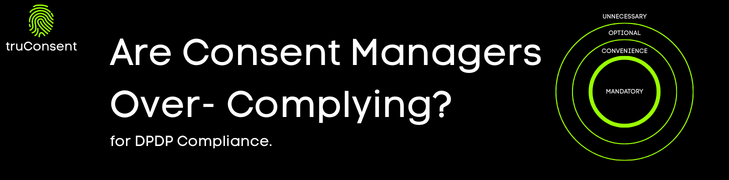
Are consent management platforms pushing enterprises toward over-compliance?
I’ve had this conversation repeatedly with founders, CISOs, product heads, and legal teams. Everyone feels it. Almost no one wants to discuss it publicly.
Part of the reason is simple.
This is the first time India’s data protection law is being implemented through rules, not just intent. Which means interpretation is inevitable. In the early stages of any regulatory regime, the industry tends to over-correct.
So yes, friction exists. And yes, some over-compliance is happening.
But the real question isn’t whether it’s happening.
It’s what actually constitutes DPDP compliance, and where platforms quietly cross the line into unnecessary burden.
What Is Non-Negotiable Under DPDP
From a consent manager’s perspective, two things are foundational. Not optional. Not “phase two”.
Consent is the entry point. Rights are the proof of seriousness.
Consent configuration needs flexibility. Different purposes, different data sets, different journeys. This is not a static checkbox problem.
But the consent notice itself is non-negotiable.
Clear. Purpose-specific. Unambiguous. No dark patterns.
Is that over-compliance? No. That’s the bare minimum the law expects.
On rights:
Access.
Correction.
Erasure.
Withdrawal.
And no, not via an email alias. Not via a PDF form. Not through a support ticket black hole.
Rights must be as easy to exercise as consent was to give.
Anything less is compliance theatre.
Where Things Start Getting Murky
This is where platforms start bundling “compliance” with convenience, and enterprises need to think carefully.
Discovery and Data Mapping
Is it mandatory? No.
Is it useful? Absolutely.
Even if you know the client application inside out, configuring consent correctly takes time. Discovery and mapping tools reduce friction, especially in complex systems.
We tested this ourselves on an application we built and hosted.
The value was convenience and speed, not compliance obligation.
Scanning and mapping done well is powerful. That’s why we built truScanner as open source.
Helpful, not mandatory.
Data Processor Management (TPRM)
A consent manager offering third-party risk management does not automatically make it mandatory.
If you already have a TPRM solution, keep using it.
If this is your first structured attempt at managing data processors and you have the bandwidth, an integrated module can be useful.
But buying a consent manager because it includes TPRM is unnecessary.
DPDP does not require tool replacement. It requires governance.
Breach Management and “AI-Driven Detection”
This needs to be said plainly.
Anyone selling automated breach reporting should be avoided.
Breach detection may be assisted by tools.
Breach reporting must never be automated.
Reporting a breach is a legal decision. Context matters. Materiality matters. Human judgment matters.
If a platform claims AI-driven detection and automated reporting, that’s not innovation.
That’s dangerous. Skip it.
Audits and Assessments
DPIAs, when done properly, are deep, contextual, and human-led.
A consent manager is a product. Not a consulting firm.
Where a platform can add value:
- Sampling-based reviews of consent propagation
- Log-based analysis to validate processing against consent
- AI-assisted reviews to surface inconsistencies
But this must be optional, affordable, and assistive.
Anyone claiming to fully replace DPIAs with software alone should trigger immediate skepticism.
Minimum Security Safeguards
This is about evidence, not perfection.
Mapping existing controls, policies, and safeguards matters.
If you already use compliance tools, integrations should be enough.
If you’re managing this in spreadsheets today, a centralised module may help.
Again:
- Optional
- Proportionate
- Priced reasonably
Over-engineering security controls inside a consent manager is not compliance.
It’s clutter.
The Line That Matters
DPDP compliance is not about stacking modules.
It’s about proportionate systems that reduce risk without freezing operations.
Over-compliance helps no one.
Not businesses.
Not users.
Not regulators.
Good compliance is boring. Quiet. Defensible.
That’s the bar.